What differentiates man from animals is the ability to look forward to tomorrow and to look beyond the externals. While man can see beauty in a flower and think of either God or a loved person and even of love itself, a beast will stop short at seeing the flower as something good to eat or not.
What makes man worthy of the same name is his capacity to see beyond the here and now and perceive meanings.
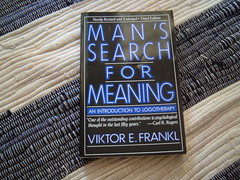
Man’s Search for Meaning (Photo credit: marklarson)
In his book, Man’s Search for Meaning, Viktor Frankl describes his experiences at the Nazi concentration camp where he was detained during World War II. In the concentration camp the prisoners were stripped of everything that made them experience personal worth: name, respect, profession, family, knowledge, wealth, etc.
He noted that some of the prisoners gave up surviving when everything that made them feel that were someone was taken away.
Others got crazy and behaved even worse than beast, capable of killing another man for a loaf of stale bread or a rotting potato. And, finally, he noted that those who had something or someone considered more precious than their own lives never lost their will to live even as they were not afraid to either suffer or die.
From this experience, he believes that man’s life and even just his survival is determined by what meanings he perceives and chooses to live and die for.
We can push the statement further by saying that a person is worth what he chooses to live and die for. Heroes and saints, as well as villains and criminals, are a proof of this statement. If heroes and saints are great, it is because they have chosen to live and die for for causes and meanings greater than themselves or things lower than themselves to live and die, like money or power.
How a man discovers what meaning to give his life is a story of both the environment he lives in and the choices he makes. What counts is what values in life he discovers and ultimately makes his own. “Where your treasure is, there your heart is also.” (Mt 6:21)
One of the most trying things about being young is that of being in a stage where one has to choose what values to live and die for. Human society is full of models and examples of persons who have embraced their own values. If there are rock stars and actors and actresses making it to the limelight and to wealth, there are also those who, like Francis of Assisi of long time ago, leave behind them a life of ease and comfort to pursue ideals of nobility and service. And what is awful is that today’s young man or woman is left alone to choose.
To discover which model one has to choose, one need not look beyond or outside himself. Instead, one should look into his heart. If he does, he will surely discover passions and drives that are either constructive or destructive: his capacity to love or hate, to give or possess, to build or destroy, to forgive or avenge. When he chooses what is positive and shuns what is negative, he will naturally discover what model or example to embrace. And there he will discover the meaning in his life.
The year was 1977, and Ferdinand Marcos was still the Philippine president. A few months back, Jimmy Carter was sworn in as the 39th President of the U.S., and I had just completed my freshman year in college.
It was our summer vacation, so earlier that week, Ray and I decided to go biking to the hills of Antipolo, Rizal (a quiet but relatively large town approximately 20 kilometers (12.4 miles) northeast of Manila).
I woke up at about 4:00 AM that Sunday, put on my cycling gear, and poured the de-fizzed Coke I had placed in the fridge the night before into the plastic bottles attached to my bike.
After a brief inspection of my steed (tires, gears, brakes), the road map, and my camera, I rolled on — to the scent of fresh-baked ‘pan-de-sal ‘ (small bread buns) in the still-dark streets of Parañaque and headed towards Pasay City…where Ray and his family had moved.
Ray and I were childhood friends in Baclaran, where his family had lived, even by the day I began remembering things. That was until the owner of their apartment unit decided to lease out the entire complex to a Chinese businessman, forcing them to move elsewhere.
He was younger by about 6 years, but we shared the same interests: playing all sorts of street games, billiards, ‘dama‘ (a local version of checkers, usually played in barber shops), swimming at the Manila Bay -its water was still relatively clean, and people could still catch some fish – and, of course, biking.
I called his name through the window in his room, conveniently situated on the side of yet another apartment complex along Facundo Street. He had already prepared the night before and, in no time, we found ourselves pedaling furiously eastward to Pasig, Rizal, which is now a city and part of greater Metro-Manila.
Although not very far from Manila, Antipolo is a cyclist’s bane, as most of it is situated on the eastern slopes of the Sierra Madre mountain range, offering spectacular views of Metro Manila.
But why did we go biking there? It was the month of May, and traditionally, people, especially in predominantly Catholic Philippines, from all over the country, trek to the place to pay homage to the ‘Nuestra Señora Dela Paz y Buenviaje‘ (Our Lady of Peace and Good Voyage) – a black-imaged Virgin that came from Acapulco, Mexico, that was used during the Galleon Trade. Also, numerous spring resorts in Antipolo offer a bit of relief during the country’s hot summer months.
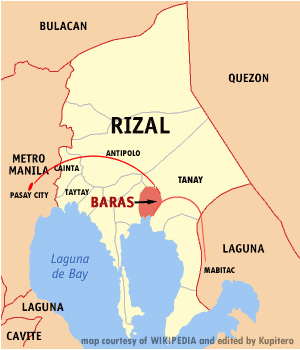
Map showing our starting point in Pasay City (Metro Manila) and the towns of Rizal Province we traversed en route to Laguna.
It took us about two hours to reach the church. After we said our prayers, we bought some ‘kasoy’ (cashew nuts), also abundant in the area, as with the ‘Tipolo’ tree (breadfruit), which the place got its name, and snapped some photo souvenirs, we decided to continue our trek southward to the neighboring towns of Tanay and Baras. Both are still situated in the province of Rizal.
It was mostly downhill from Antipolo, along undulating roads, toward Tanay. So we decided to eat lunch in one of the roadside ‘carinderias‘ (eateries)- they are so ubiquitous along the main highways of the entire archipelago – not long after we reached the flatter sections of the town.
I forgot what we ate, but remembered that we drank more than we ate because of the noonday heat. I also ensured that my two water bottles were full for the impending climb towards Mabitac (part of Laguna Province) via Baras and, once again, Tanay.
I almost gave up as soon as we reached the brutal climbs in Mabitac. Ray, who was riding his trusty ‘play bike,’ was egging me on to continue without realizing that my steel road bike was climbing these slopes on a maxed-out 48-tooth (front chain wheel) by 18-tooth (rear gear) combo while he was leisurely pedaling on a smaller wheel with a 32 by 20 gear ratio!
I barely made it to the top! The cool breeze and the panoramic view of the Laguna de Bay gave me the ‘second wind’ I needed to pursue the journey further south. Besides, the trip back via the same roads would have probably been torture!
The rustic sceneries and the ‘genteel feel’ I had for the small ‘barrios‘ we passed by en route to Mabitac (one of the three towns in Laguna that bordered the province of Rizal – the others being Pakil and Santa Maria) made our pedaling easier than it seemed to be.
From their ‘verandas‘ (porches) or, in front of their hardware stores, old men and women waved at us as we wheeled by.
As if our souls had briefly met high above the clouds and then looked down with puzzlement at the chaos and confusion people were creating for themselves on earth.
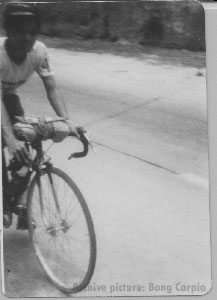
Rolling along the roads of Baras en route to Laguna via Mabitac in this 70s photo
We bade goodbye to the mountains as soon as we entered the municipality (or town) of Famy in Laguna. It is a small town whose western tip briefly borders Laguna de Bay. Most towns in Laguna straddle this great lake, a source of livelihood and many folklores.
From there, the twisting roads of Siniloan led us to the more significant, eastern part of Pangil — vernacular (in singular form) for the ‘fangs of wild boars,’ which were said to be abundant and freely roamed the place.
It rained briefly while we were gingerly traversing a downhill section towards neighboring Pakil. These towns I remembered well as the “three Ps“…the next one being Paete — very well-known for its wood carvings and the sweet and succulent fruit, ‘lanzones.’ How could I not remember the sense of awe Ray and I had felt as we whizzed by these trees with their light-yellow, oval-shaped fruits right above our city-bred heads? We were not used to seeing those trees!
Also, most houses in Paete have small thatched huts, usually detached from their prominent abodes, where their owners can do their carvings. Some of these huts also double as small ‘sari-sari‘ (assorted goods) stores to augment their income.
In one of these ‘sari-sari’ stores along the highway in Paete, Ray and I tasted one of the best ‘pan-de-cocos‘ (bread rolls with sweet coconut fillings) in our lifetime. It was not because they were well-baked but because we werehungry after the lung-busting climbs. We washed them with “Sarsi” (a local brand of root beer, whose aromatic flavor comes from the ‘sarsaparilla‘ vine) and lots of swigs from my now slightly hot water bottles. It was about 2:30 PM, and from Ray’s house in Pasay City, we had been on the road for more than 9 hours!
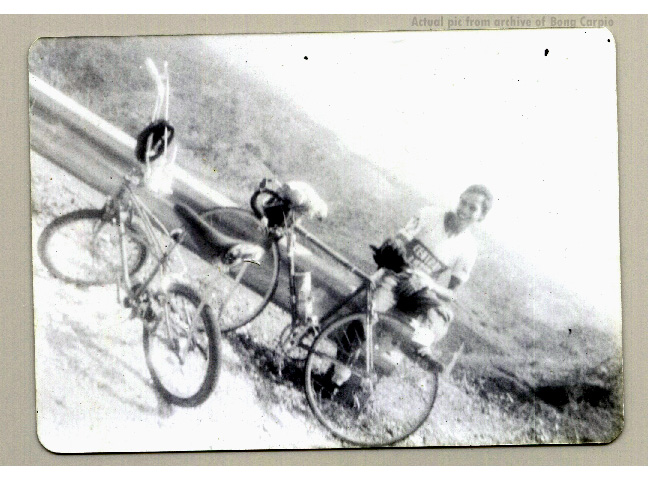
Atop one of the steep hills in Mabitac for a breather. Ray Nario snapped this picture of the author.
And so, we pedaled on to the towns that caressed the southeastern portion of Laguna de Bay. These were: Kalayaan, Lumban, Pagsanjan (although not bordering Laguna de Bay, we decided to pass through this town en route to Santa Cruz because of its popularity and allure), Santa Cruz, and Pila.
It was in Pila where we stopped briefly again to sample one of the roadside delicacies, ‘suman‘ (a long, sticky rice cake whose flavor is enhanced by the coconut leaves it is wrapped in). These we dipped in plain sugar for taste and to replenish our already-depleted body sugar reserves.
I also happened to have a university mate and friend who lived in town, and we briefly considered looking up his house and paying him a surprise visit. But it was almost 5:00 PM, and although it was the peak of summer, we were running out of daylight to cover the remaining nine Laguna towns and cities — and the more than 90 km of not-so-very-easy roads back to Manila. Also, given that our frail bodies were running on whatever glycogen reserves we had, we backed out of the idea and pedaled to the adjacent town of Victoria instead.
From Victoria, our pace was getting slower and slower as we trundled past the towns of Calauan, Bay, and Los Baños, where its steep hills almost zapped the lights out of us and nearly gave in to the thought of sleeping the night over as soon as we hit the town proper.
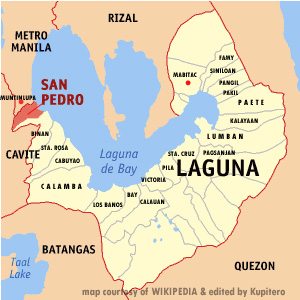
Map of the province of Laguna showing the towns we traversed on that day in 1977 – (shaded yellow with red line)
We knew that we were not far from home as we stopped briefly in the town of Los Baños — very near the road that leads to the International Rice Research Institute (IRRI), situated inside the University of the Philippines at Los Baños‘ (UPLB) sprawling compound.
We were also very familiar with the towns and cities we would pass along the way. Los Baños had been one of our favorite cycling haunts from Manila because of its natural, relaxing hot baths, which are purported to have medicinal properties.
Once again, the downhill-to-flat run from Los Baños towards Calamba boosted our already flagging spirits. We saw the last streaks of sun rays as it finally set on the western horizon as we approached the historical city. Calamba is the birthplace of the country’s national hero, Jose Protacio Rizal.
In one of the restaurants in this time-tempered city, it was only fitting that Ray and I talked over cups of coffee about the roads we had covered and the ordeals we had gone through. We had traveled far and well.
More importantly, we could see through our inner selves… our strengths and weaknesses, our tempers and moods, our bravado, our follies and foibles – as well as our determination. We had lived through yet another day in our youthful lives.
Darkness was upon us as we agreed to move on, for as long as it was not too dangerous for us to ride through the remainder of the journey. And so, we pedaled on to the rest of the towns in the partly-lit roads of Laguna: Cabuyao, Santa Rosa, Biñan, and finally, San Pedro.
It was almost 10:00 in the evening.
We still squeezed some sugar out of our sore leg muscles and moved on to the first municipality on the western side of Rizal Province: Muntinlupa.
Like Pasig in the north, Muntinlupa is now a full-fledged city — the southernmost of greater Metro Manila. While we were just 20 kilometers from Pasay City, it was also here that we finally ended our bicycle saga — for health and safety reasons.
At the BLTB (Batangas-Laguna-Tayabas Bus Company) terminal in the town of Alabang, after asking the driver for permission, we hauled our bikes to the rearmost seat on the almost-empty bus. We slept soundly on the long, foam-padded backseat on our way back to Pasay City.
We had finally come full circle.
BIKE NOTES:
Ray used a ‘Patria‘ brand (a bike shop/manufacturer founded by Tony Kairuz whose main store was located in Buendia Avenue in Makati, Metro-Manila, until it closed shop in the mid-80s) steel-framed ‘play bike’ (“banana” type seat with raised handlebars) with 21″ wheels, single chain wheel with multi-gear back freewheel.
I utilized a locally made, 50 cm. ‘Pigeon‘ brand (a small bike frame builder in Paco, Manila in the 70s that was co-owned by Tour of Luzon lap winner Hermogenes Vinluan) steel-framed road bike with 27″ clinchers on Weinmann aluminum rims & steel spokes, Sugino alloy (52/38) chain wheel with a SunTour Dia-Compe 10-speed gear set (bar-end shift-levers), Universal center-pull brakes and a pair of old-school, Mikashima steel/alloy pedals with Christophe shoe cages and straps.
My nephew, Gio, flew in from Virginia with a PSP on hand. He was watching a movie on the gadget’s small yet crisp TFT screen (4.3 inch, 16:9 widescreen at 480 x 272 pixel and 16.77 million colors) via a UMD (Universal Media Disc) video inserted on the drive.
English: A Sony memory stick pro duo. 2GB. (Photo credit: Wikipedia)
The $250 handheld gaming console also has USB 2.0, an infra-red (IrDA) port, a slot for a Memory Stick PRO Duo (another Sony-proprietary format that looks like a copy of the SD (Secure Digital) card) and, interestingly, IEEE 802.11b or Wi-Fi at 11 Mbps. Note that Bluetooth was not built-in.
Curiously, the device also sports an interface that looks like a copy of Apple’s Mac OS X, sans the dock. Indeed, “Sony loves to copy Apple products to death,” as Steve Jobs (Apple’s CEO) is wont to say.
Although WiFi was built-in, the PSP’s OS lacked a browser. Connectivity was included to, basically, enable the device to have firmware updates. Configuring the unit to hook-up to the wireless network was relatively easy except for the entry of all the information required. You must be a savvy ‘text’-er (aka, SMS) to breeze through any data-entry process on the PSP.
But, the lack of a browser on the PSP is not a deterrent for veteran netheads. Using the game called “Wipeout Pure” (also in UMD format) and the old web server trick of ‘DNS-spoofing,’…yes, you can use the PSP for ‘simple’ web surfing.
Don’t expect web pages to appear in all its glory on the device’s small yet impressive TFT screen. Most of the standards in the ever-changing world of the Web are not yet supported in the browser inside “Wipeout Pure”. These, plus the use of the controls in the PSP to act as your keyboard make web-browsing on the PSP very cumbersome.
It will not take long for Sony (as well as, hackers) to integrate a built-in browser in the OS via their updates. A small keyboard can truly help as well for easier web access.
But, hey, the PSP was primarily created to be a nifty portable gaming device and not as a notebook or some sort of a ‘web-pad’. Having the capability to sniff-out free WiFi hotspots built-in on the unit makes the PSP an attractive alternative to carrying that bulky laptop!
UPDATE: Yesterday, Aug. 24, 2005, almost two months after this original posting – Sony officially announced the inclusion of a web browser in the OS via a software update.
PSP owners no longer have to purchase ‘Wipeout Pure’ just to surf the Web!
Any doctor will tell you that, diabetes, as a disease, is characterized by having an unusually high blood glucose level. While many factors cause the high glucose levels in the blood, it is the result of something that prevents the glucose from getting into the various cells of the body, where it’s needed to provide the nutrients that the cells require.
This is why it’s called “starvation in the midst of plenty.” Your body has all the glucose you could ever use, but it can’t get into the cells to go to work.
The same analogy can be used to describe how I view life -as an expatriate in the U.S.- using the iPod as my ‘aid’. Here are some of them:
I’m constantly listening to Antonio Carlos Jobim’s, “Triste” (Sad –Is To Live in Solitude) on my iPod and immediately turns nostalgic. I long for the hand-to-mouth, not-so-loaded-with-material-things yet carefree and happier existence I had back home. Nothing beats the natural design of things.
I’m constantly listening to Astrud Gilberto’s rendition of the Burt Bacharach classic, “Wanting Things” (from the Broadway musical, “Promises, Promises”) on my iPod and immediately turns sad. In spite of the material things I had accumulated in my adopted homeland, they all simply provide temporary enjoyment and do nothing to uplift me spiritually. I guess, the adage “less is more” fits the bill perfectly here.
I’m constantly listening to Antonio Carlos Jobim’s, “Look To The Sky” on my iPod and immediately turns dazed and confused. Dazed because of my utter amazement at its vastness and infiniteness. And confused, because it offers a way of ‘searching’ for any hidden clues that it may offer in my quest for some of the answers to the nagging whats and whys of living.
I’m constantly listening to Gino Vanelli’s, “Where Am I Going” on my iPod, and I’m immediately reminded of the book of Ecclesiastes in the Bible. It narrates the desperation of all our actions while we are living…the ‘nothingness’ of everything we do or had accomplished. Yet, we must consider life as a ‘gift‘ in reverence to a good and all-knowing God.
I’m constantly listening to Bebo (Valdes) and El Cigala’s (aka, Diego Jimenez Salazar) take of the classic song from Argentina, “Vete de Mi” -from the album, “Lagrimas Negras”- on my iPod and immediately turns teary-eyed. I pine for the days when the world was much younger before my eyes and when a casual walk (alone or with friends) along the beach near the town where I grew up, was enough to make me happy.
I’m constantly listening to Jean-Luc Ponty’s, “The Gift of Time” on my iPod and immediately wonder where had all my younger days gone by. Only the memories linger on.
Maybe, life -fascinating and mystifying as it is -like diabetes, is a ‘disease’ brought upon us so that we may find the cure for the ‘starvation‘ we constantly feel in our hearts, deep within ourselves, as we plod along through its very arduous course.
Now I’m also constantly listening to Sting’s, “Be Still My Beating Heart” on my iPod, and immediately, adrenaline rushes through my blood–to tackle what life has to offer…each and every day…as long as I’m still breathing.
I already felt the humidity of Bangkok the moment we stepped out of the plane to wait for the service bus that will take us to the main airport terminal. The bus’s air-conditioning hid this fact for a few minutes, and so, the muggy air blasted onto my face anew as soon as we stepped out of the airport to wait for another bus that will us take to our hotel after we had cleared immigration and retrieved our baggage.
Bangkok, despite of what I’ve read and heard from friends about the place, immediately impressed me after the almost 40-minute drive to our hotel, which was located in the heart of downtown…along Petchaburi Road. The roadways were clean and nicely engineered.
Towering concrete posts for the still-undergoing-expansion Skytrain, dotted the right portion of the freeway, but they were left neatly in place –no dangling wood forms nor rusting steel supports.
The country -temples or without- simply showed us that the people is where we sense more the ‘breath of nature’ that moves our innermost heart.
But one thing that awed me were the magnificent temples that literally lined up the entire streets of Bangkok–Budhhism being the main religion of the country. Not only they tempered the modern look of the country, but they also added ‘mystique’ to the already-exotic place.
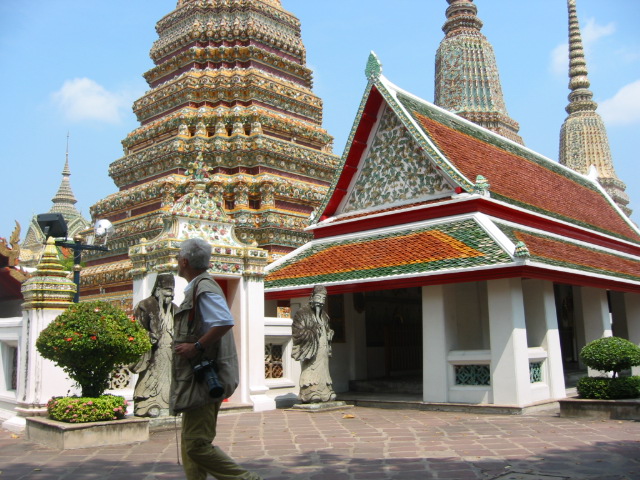
One of the smaller temples inside the Wat Po (the new name is Wat Phra Chetuphon) ; location of the massive “reclining Buddha”.
After a brief, albeit, refreshing sleep, quick showers followed by the hearty breakfast buffet in our hotel, Bangkok and its magnificent temples, would, once again, dazzle us during the 6-hour morning city tour.
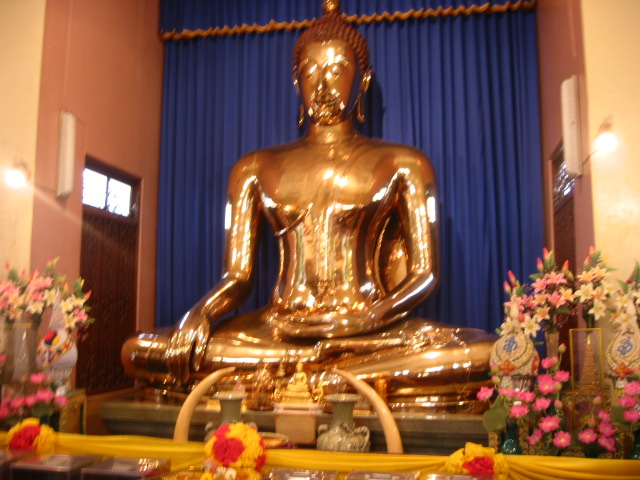
The city tour showcased most of the popular -and bigger- temples in downtown Bangkok that included, the Wat Phra Chetuphon Temple (more popularly known as the ‘Wat Po‘ where the massive ‘reclining Buddha‘ is housed) and the Traimitwitthayaram Temple inside the Chinatown district, where the ‘largest Buddha made of pure gold‘ in the world is located.
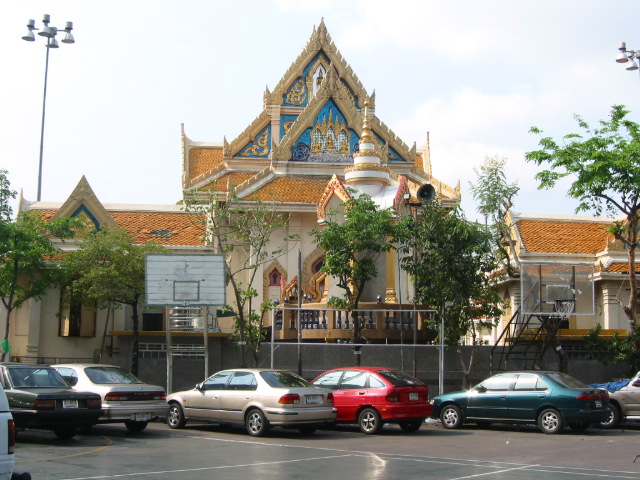
One of the smaller temples inside the Traimitwitthayaram Temple Compound where the “largest Buddha made of pure gold” is housed.The “largest Buddha made of pure gold” inside the temple.
Finally, on a trip to the countryside the following day, Thailand not only showed us its gentler side but also visually reminded us that, “all that glitters is not, necessarily, gold.” Why? Inside those temples, while the beauty and craftsmanship of all the icons and statues may mesmerize visitors, they all paled in comparison with the natural warmth and friendliness of the Thai people.
I knew it would be hot and humid, but I went with my wife to visit Manila by the end of March. After all, it had been almost three years since I last sauntered upon its streets — to see again the places that had been mute witnesses to my frivolities in the early years of my adult life.
A few days after our arrival, we began exploring the districts of Santa Ana, Paco, Ermita, and Malate, as well as portions ofIntramuros (the “Walled City” during the Spanish colonial period) and San Andres (formerly part of the Santa Ana district).
The main stretch of Pedro Gil Street (formerly Herran), from Roxas Boulevard to its dead end at the historic Santa Ana Church, where it continues as New Panaderos Streetheading towards Mandaluyong City, offered me a snapshot of what the entire city had gone through over the years.
As always, the area offered a mix of déjà vu, fascination, sadness, and desperation — I had known almost the entire vicinity since I was still an elementary student at nearby Malate Catholic School in the late 1960s.
Not much had changed in the heart of Paco and Santa Ana. Jeepneys, cars, and tricycles, compounded by the narrow streets, continue to choke the area, while numerous patches of urban blight seem to haunt these places perpetually.
The current mayor of Manila has made an effort to give the entire city a fresh look by opening up most of the city parks—the “Paraiso ng Batang Maynila” (Paradise of the Child of Manila)—and installing old, Spanish-style lampposts (ala-Intramuros) throughout the main streets. However, they, too, had become victims of what afflicts the entire archipelago – very poor (if any) maintenance of these improvements and the short-sightedness in planning and design of its overall infrastructure.
Malate and Ermita have seen the most changes due to the construction of new high-rise buildings along Roxas Boulevard, A. Mabini Street, M.H. del Pilar Street, and Taft Avenue, as well as the redevelopment of the bayfront from Vito Cruz Street (near the Cultural Center of the Philippines to Rizal Park (Luneta Park), which Manilans fondly refer to as “Baywalk.”
At the back of the Manila City Hall, along Arroceros Street, I saw the rise of a big mall. However, its overall design – resembling a large piece of hollow block – made the entire vicinity appear less appealing than it once did. Who knows what happened to the small business establishments that once abounded in the area before the mall was built? Gone were the genteel shops and the post-war YMCA that once thrived when the GSIS (Government Service Insurance System) and the DECS (Department of Education, Culture, and Sports) were still located in the same area. Even the improvement of the park (part of Mehan Garden) along Concepcion Street did little to counter the bland look the mall gave to the area.
The sad state of the entire place says a lot about how city managers (present and former) interacted with businessmen and prospective investors to make the place not only commercially vibrant but also to ensure that these establishments blend beautifully, without neglecting its history, with the entire area.
A few days later, I was sweating it out in the districts of Quiapo, Santa Cruz, and Binondo, as well as passing through the San Miguel, Sampaloc, and Santa Mesa districts via jeepneys and the newly built LRT 2 (Light Rail Transit 2 – the “MegaTren”). I had already seen the changes made by the incumbent Manila mayor in the Quiapo-Plaza Miranda areas back in 2002, which, at least, sanitized the Lacson Underpass of vendors, pickpockets, and petty crimes.
While the traffic situation in the vicinities of Manila may have improved because of the LRT 2 -which runs all the way from Recto Avenue to Santolan Road in Quezon City-, the entire city still need a lot of changes in its overall infrastructure (majority of its sidewalks are dilapidated), for it to become at par with its already-modern Southeast Asian counterparts.
Starting from Quinta Market underneath the Quezon Bridge (also known as Quiapo Bridge), we meandered our way to Escolta via Carlos Palanca Street (Echague), passing by the statue of the late Manila mayor, Arsenio Lacson, as well as the nearby Santa Cruz Church, located within the renovated portion of the plaza.
We ambled towards Binondo via Tambacan Street, stopping briefly at Ongpin Street to buy some “machang” (steamed sticky rice with cooked pork or chicken at the center, wrapped in banana leaves) and “siopao” (steamed buns with braised pork/chicken inside) as “pasalubong” (household presents).
Then, it was time to acquire some affordable hardware/home furnishings along Tomas Mapua Street (Misericordia), for which the street is known. We ended our ‘mini-Chinatown tour’ on one of the tables at the ‘Pinsec Noodle House’ (wow, it’s still there!!) along Claro M. Recto Avenue (formerly, Azcarraga), where we enjoyed my old favorites: “beef asado” noodles (braised beef w/ noodles) and “siopao asado”(steamed BBQ pork buns). After washing these down with our favorite soda, a few steps away on Rizal Avenue (Avenida Rizal), we were surprised by one of the most notable changes in the vicinity.
The stretch of Rizal Avenue from Plaza Lacson (near Carriedo) to Claro M. Recto Avenue was ‘pedestrianized.’ The old cement road and the sidewalk were replaced with bricks, and assorted, colorful plant boxes were placed along the sides. Benches made of wood and stainless steel were placed in the center for promenaders to sit on. Lampposts were added to complement the dim lights underneath the LRT 1 (Baclaran to Caloocan City) tracks.
The pedestrianization project, indeed, brightened up the area, and with the ongoing construction of a mall (hopefully, with a design that could recreate the grandeur or ambiance of the place after WW II) where the former Odeon Theater was located -as well as the timely opening of the modern, 4-story, LRT 2-Recto Station nearby-, ‘Avenida‘ as it was more popularly called, may well have found the recipe for its rebirth.
We almost walked the entire length of the ‘new’ Avenida, from where we veered left towards Gil Puyat Street (formerly Raon Street), the ‘electronics capital‘ of the country. Here, scores of vendors offered us an assortment of goods, ranging from the cheapest electronic parts and equipment to counterfeit audio CDs, VCDs, DVDs, and almost anything related to the fake mobile phone parts industry (very few were legitimate).
I also got a new pair of eyeglasses for only US$25 in this area. Time was well spent, as we also ambled to nearby Quiapo Church (we had come full circle), where we saw the popular sculpture of the “Black Nazarene” (“Jesus Nazareno” –and devotees hold a procession for it yearly). I wished that it would grant us more time on our next visit.
We also got a few bags of freshly-made “hopia” (round, flaky pastry with different fillings inside – very popular of which is the ‘mongo‘ (mung) beans made into a paste), “chorizo Macau” (Macau pork sausages), as well as a cheap CD case (less than a dollar) as we headed back to pick up the eyeglasses at the optical shop located along Pedro Paterno Street.
We were exhausted now, so we ambled back to the LRT 2-Recto Station via Evangelista Streetand took one of the lovely, roomy, and air-conditioned trains to V. Mapa Street in the Santa Mesa district, which also passed through the Sampaloc district.
In Santa Mesa, we took a quick -and very cheap at about $2 for the two of us- lunch of pork BBQ-on-a-stick, “menudo“ (diced pork and potatoes in tomato sauce), a dry version of the “papaitan“ (sauteed goat innards with lots of onions and chili), free “sabaw” (soup), lots of rice and a bottle of cold Coke to cool-off the noonday heat that had built-up on our bodies. In this area, we took one of the two jeepney rides that brought us back to Barangay Hulo, Mandaluyong City, where I spent most of my month-long odyssey.
I might miss Manila occasionally as I continue to toil in another country for my livelihood. But the place, much less the entire country, had slowly progressed to miss it longingly.
Corruption, apathy, and the perverted sense of nationalism among the majority of the people have been the bane of the country, and reaching the next important step to becoming a truly progressive nation remains elusive for Filipinos.
It’s still challenging to enjoy living in luxury in a country where most people struggle to make a living. Part of it may be their fault, but the greater blame lies squarely on a government that perennially fails to deliver on its fundamental purpose — to uplift the socio-economic status of its constituents to the next level.
Ever since I got a $5.40 bill from Cingular for using their GPRS (General Packet Radio Service) network for ONLY about two (2) minutes-to access the Philippine Daily Inquirer’s website (www.inq7.net)- using my old but trusty Treo 600, I had long been aching to have WiFi access on this gadget.
Using GPRS for web browsing isn’t just the way to go these days. It maybe convenient for e-mail and SMS (where our friendly phone companies charge very minimal fees), but GPRS for web access is not only slow compared to WiFi but it is also painfully expensive (Well, at least, here in the U.S. Someone informed me that Telefonica Movistar, for sometime, offered data service via GPRS in Mexico for free). The only advantage of GPRS over WiFi is that the former goes together wherever your phone signal is available. The latter…well, you’re constantly in the lookout for ‘open’ WiFi networks or, the nearest Starbucks or Borders.
The Treo 600 as well as the newer 650 model didn’t come with built-in WiFi. Maybe, PalmOne wants you to also get their Tungsten C or any of their new PDAs that can use an SDIO WiFi card like the Zire 72. Since free WiFi hotspots had been sprouting like mushrooms all over the world in the past two years, why not take advantage of them?
Treo 650 users had been buzzing for the last 3 months now with the release of a hack for the SDIO WiFi card that PalmOne specially designed for the Tungsten T2, T5 and the Zire 72. The SD WiFi card sells for US$129 at the PalmOne Store while the hack is available at www.uneasysilence.com
In this picture comes in Enfora, Inc. – a Texas-based company that had been involved in mobile computing solutions since 1999. Last March 10, 2005 they issued a press release on their website stating that they will offer a ‘WiFi-sled’ for both the Treo 600 and 650. This is very good news for Treo users that had long been dreaming to have WiFi access on their beloved devices.
The last company that tried to address this shortcoming by PalmOne was SanDisk. They were able to come out with an SD (Secure Digital) WiFi card for the Pocket
Treo 650 (Photo credit: aditza121)
PC platform but failed to deliver one for the Palm OS platform –specifically, for the very popular Treo 600 due to power constraints.
WiFi cards are, indeed, power hogs. Even most notebooks with WiFi cards built-in or connected via the PC Card slots and are in use, can have their power juice run down quickly compared to ones not actively using their WiFi cards.
What’s promising about Enfora’s approach is that, the ‘WiFi sled’ is a device in itself where the Treo 600/650 slips in. Hence, it has its own power source and will also charge the Treo as well. But how the device will behave in wireless data mode using WiFi is a big question. Can a call comes in while web surfing? Will other built-in apps on Palm OS 5.x work well with the bundled software?
But, just like ‘vaporware’, a press release is a great way to whet the appetite of people eagerly waiting to lay their hands on the actual device. Whether Enfora (www.enfora.com) can actually deliver these products in the market before PalmOne finally comes up with yet another new version of the Treo with built-in WiFi, remains to be seen.
12/11/2005 addendum:
In the first week of September 2005, the WiFi sled for both the Treo 600 and 650 became available to the general public by showing up in retail store shelves like CompUSA as well as online stores.
He used to come often to our store/house in Baclaran (a ‘barangay‘ -smallest administrative unit of the government- in the then, town -now, city- of Paranaque, which is a mere 2.5 miles south of Manila) to visit his younger brother (my father) as well as to acquaint us with his latest interest — which was quite diverse.
Those years were in the 1970s and 1980s, when I was old enough to understand the things he discussed with my parents. It was also in those days that I was able to glean that he, not only was my uncle but also was my grandfather by co-sanguinity — his wife (whom we fondly called “Lola Paring“) being the aunt of my mother.
Most of the time that he was with us in Baclaran (and if I also happen to be at home), there was always a discussion -over cups of instant coffee- that centered on his vast array of interests: honey bees, silk culture, alfalfa, grapes, pigeon-breeding, vitamins, mushrooms, asparagus sprouts, oranges, and many other agri-related topics.
His interests and how he explained them to all of us were presented with such enthusiasm and persuasiveness that he was also able to convince my mother to sell the pure honey contained in ‘patis‘ (fish sauce) bottles in our store.
Every New Year’s Day, when he was still residing in Grace Park, Manila (part of what was then known as ‘Manuguit‘ or presently Jose Abad Santos Avenue in Manila’s Tondo district), our family made an annual trek to his house, as it was his birthday.
I used to recall those visits with great anticipation because they were one of those infrequent occasions when our store would be closed. Not only will we be free from store work for the entire day, but we will also always look forward to what Tata Fidel and his family will serve us that day with delight.
I especially loved the fried chicken, the “house special”, and the very delicious cakes and pastries they made.
I knew he was not a good cook, but it happened that one of their tenants in the mixed-apartment building they owned was a restaurant, and for a time, they also operated a small bakery in the same building. Hence, while there were plenty of good foods, “good talks” were also awash every New Year’s Day.
Growing up, he would badger me -as well as the rest of my siblings and cousins – to take up courses like orthodontics, X-ray technology, and baking, and constantly reminded me of the benefits of taking up short courses at trade schools like PCAT (the Philippine College of Arts and Trades, presently known as TUP, Technological University of the Philippines).
But what I remembered best about my Tata Fidel was his passion for exploring natural methods to stay fit, trim, and healthy. It was a natural diversion for him, having been a successful businessman who operated a battery repair/re-manufacturing shop and then an auto parts supply store in Pasay City immediately after World War II ended.
He also ventured into other businesses, including a small bakery and a garment factory, after semi-retiring in the early 1970s. These were not long after he ensured that his family was financially secure by making some brilliant real estate investments during the years they still operated the auto parts shop.
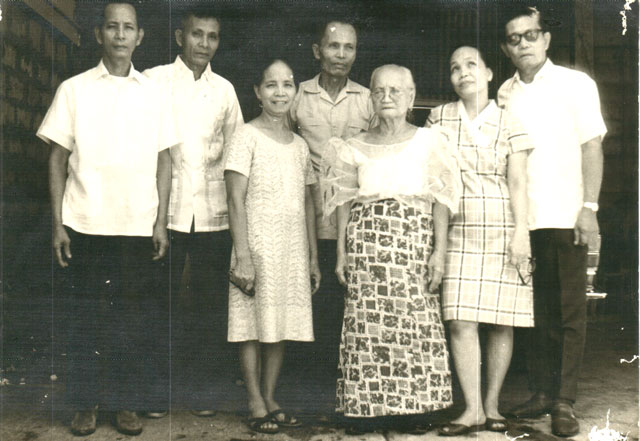
Tata Fidel (extreme right, with glasses) with siblings and mother. The author’s father is on the far left. From left to right: Kiko, Amado, Terya, Ambo, their mother (Lola Belay), Oliva, and Tata Fidel. Not pictured is Tata Mundo.
He was so passionate about health and organic foods that he bought a parcel of land in Plaridel in Bulacan province (adjacent to the Tabang Toll Booth on the North Expressway), so that he could put his interests into practice.
There, he planted (or tried his best) grapes, mushrooms, and asparagus (these were not known to grow very well in the country’s tropical climate — much more, in very humid Metro-Manila at that) as well as a variety of crops common in the region.
The place was a proverbial gardener’s paradise, with a modest house—made of wood, bamboo, and concrete—surrounded by all the greenery. He even had a ‘mini-lab’ in the basement of that house, where he kept his collection of seeds and various plants, whose names I didn’t even know existed in the Philippines.
Those were the days I remembered my Tata Fidel best. Except for a mild hearing loss that he remedied with the use of a hearing aid, he remained energetic, full of life, and still healthy, even in his early 80s. Still strong for his advanced age, he can still crush those bottle crowns with the force of his fingers, using only one hand, while I watched with awe. A feat I wasn’t able to accomplish at my relatively young age of around 30 back then.
The last time I had the chance to see him was in the late 1990s, a time when I was preparing to migrate to the U.S. I had the opportunity to accompany him to a drugstore to pick up some of his medications before he returned to Bulacan.
I did not bother to ask him what those medicines were for. And, didn’t I notice any changes in his health? He was, for me, the same strong and health-conscious man, continually lecturing me on the benefits of natural foods and organic medicine.
This year, about the middle of February, he was gone. This led me to wonder, once more, about life’s real meaning—the whys and hows of creation and death, and why we, mere mortals, have to endure all these events that seem to have happened before—in a never-ending circle.
What are we living for?
I may not be able to come up with an intelligent answer over the course of my own personal odyssey…in my very own lifetime. But I’m sure of one thing: life’s memories, for as long as one lives, linger on.
And, I’m also sure that my Tata Fidel had truly accomplished what he was here on Earth for.
NOTES: The picture above is their family portrait with Tata Fidel on the extreme right (with dark glasses). From left to right: Tata Kiko (+ -this author’s father), Tata Amado, Nanang Terya (+), Tata Ambo (+), Lola Belang, the family matriarch (+), Nana Oliva (+), and Tata Fidel (+). Not pictured is Tata Mundo (+).
2016 Update: In late August 2012, the author’s father, Tata Kiko, also passed away at the age of almost 94. He was born Oct. 12, 1918, in Hagonoy, Bulacan.
2020 Update: Tata Amado passed away in Talavera, Nueva Ecija, Philippines, in 2017, while Nana Oliva died peacefully in her sleep — late July 2020 in Cerritos, California.
At US$519 (discounted price at that), the NVIDIA GeForce 6800 Ultra PCI-X video card costs more than the new Mac mini from Apple. What??? A $519 video card??? Yup, and that’s just the start of the upgrade path to take full advantage of the features of this hot, new graphics board.
A good graphics card always complements a top-notch PC
Video cards are getting as big as a whole system itself
Why buy it? Once upon a time, when games and video displays were running side by side with 8-bit or 16-bit microprocessors, simple ISA video cards with 128K of memory were more than enough. But during those days, the newer flavors (or, ‘up-comers’) back then – the VLB (VESA Local Bus) video cards with either 256KB, 512 KB or even a hefty 1 MB of VRAM-, will cost as much as these new PCI-Express video cards that I’m referring to.
People bought VLB video cards then like they will buy these new PCI-Express video cards now: so that they can play the latest and greatest video games or manipulate digital images at speeds unheard of before.
In the realm of personal computing, where time seems to be measured in gigaflops, the distant past will most likely be only 3 or 4 years ago and where the past 10 or 20 yrs will be already be akin to living in the last century or so.
At the heart of this new video card ‘revolution’ is the game called “Doom 3”. Doom 3 requires massive computational speed such that sheer CPU power is not enough. You have to have a video card that will take off as much load from the CPU and hardware memory and process those video images and spew them off your video monitor in blazing frames per second to give our eyes better “candies”. The faster the frame rate at higher resolutions, the better the video card.
In this aspect, come in these new PCI-Express video cards that are beginning to trickle in the mainstream graphics market. ATI and Nvidia are the major players in the graphics industry today and their products are what avid gamers and graphic designers are snapping-up these days. One MUST have the proper motherboard that support PCI-Express to use any brand of these new PCI-X graphics cards.
Why PCI-Express and not AGP? PCI-X – as it is commonly termed today and was known as “3GIO” a while back – is the latest and greatest video interface today. AGP and its 8X incarnation had been around for awhile since taking the crown away from PCI when the initial Pentium II processors appeared in the late 90s. It promises almost 4 times the bandwidth as AGP 8X using the same graphics chipset. Some people are saying that there is hardly any difference, performance-wise, of video cards with the AGP 8X or the PCI-X interface, using the same graphics chipset.
But, history will tell us that, newer but industry-accepted and adapted technologies will always perform better because of the new features that will come up for them in the years to come…until a new and better standard will arise and replace it — and the cycle continues.
For now, with support for as high as 2048 x 1536 (double that of today’s very common 1024 x 768 flat-panel resolution) at 16.7 million colors, SLI-ready and featuring the new TwinView architecture, this new video card will enable you to play the next generation of video games and more than enough to handle your daily Adobe, Macromedia or AutoCad routines.
Video ports galore on the Nvidia GeForce 6800 Ultra
What’s more, its hefty 256MB of GDDR3 memory, DVI-I (digital), DB-15 SVGA (analog) and single S-Video outputs are sufficient enough to drive all those extra monitor and TV at home or office –all at the same time!
For game fanatics and video card nuts..happy days are yet to come!!!