

After 21 years as a Netflix member, I finally canceled the service in August 2019.
Did I miss it? The answer is 10% YES and 90% NO.
For me, the service was no longer a necessity, so dropping it from the monthly household bill was an easy decision.
But what were the real reasons why I decided to terminate my Netflix subscription? For one, it was not really the cost. The last monthly bill was only for $15.99 (Premium Plan).
In the U.S., Netflix started in 1998 as a DVD-by-mail service. By late 2006, it began offering a few movies to stream online, but only on PCs.
When standalone media streaming devices like Roku, Apple TV, Fire TV, and lesser-known brands proliferated, Netflix launched streaming-only subscriptions in 2010.
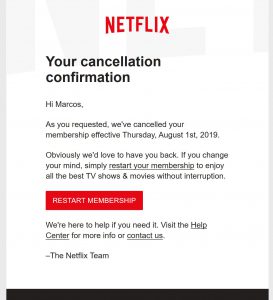
In 2011, Netflix split off its DVD-by-mail service (dvd.netflix.com) and streaming-only service (Netflix.com). While both units are still active and profitable (note: the DVD-by-mail service is available only in the U.S.), its streaming-only business has driven most growth because it could offer the service globally.
This brings me back to the question: why did I terminate my Netflix (streaming-only) membership when it was such a good deal?
Here are my answers:
#1. Amazon Prime. Yes, membership* ($119 plus tax a year or $10.90 a month, tax inclusive) with the world’s online superstore includes unlimited viewing of Prime Video movies. Their selection has grown by leaps and bounds, despite being a latecomer to the streaming-only business.
When I had both (Netflix & Amazon Prime), I watched more movies I liked on Prime than on Netflix. Moreover, most movies available on DVD sometimes don’t make it to Netflix in a streaming-only format—but I happen to find them on Amazon Prime.
And if you love documentaries and other hard-to-find movies in the streaming-only format, nothing beats Amazon Prime.
#2. Free Streaming Sites (ad-supported or totally-free). During the last three (3) years alone, the apps, as well as Internet TV channels that are in my media streamers and Smart TVs, have grown to a gazillion.
Although some have come and gone, in the U.S., apps like Tubi, Roku, Popcornflix, Pluto, FilmRise, IMDb (acquired by Amazon), YouTube, and tons of others have offered both totally free and ad-supported movies and TV shows for the last few years.
You can even have a totally-free (yes, no ads) streaming service by just being a member of your local library. In the U.S., this service is provided by Kanopy.
The apps or websites, as well as content aggregators mentioned above, may not have the latest offerings or may come only in SD (standard definition) format, or they may have viewing caps (like Kanopy, at fifteen (15) movies a month); the tons of choices from all of them are more than enough for the casual viewer.
#3. Your Internet Service Provider (ISP). Most ISPs in the U.S. today have their own streaming-only portal built into the service. They offer both free and paid streaming videos, and some – like Comcast/Xfinity– will even give you a free media streamer of their own.
Comcast/Xfinity just recently renamed their video streaming portal Peacock.
Lastly, #4. Netflix itself. A lot of movies released on DVD don’t make it to Netflix’s streaming-only format—which was the main reason I joined them in 1998.
In its early days, it offered the best selection of movies on DVD from the comfort of your home, with free shipping and no late fees.
Their concept was such a huge hit among movie buffs that it forced the big brick-and-mortar video rental firms like Hollywood Video and Blockbuster out of business.
To keep their streaming-only customers beholden to the service, they resorted to producing their own films and TV shows. And released they did – all episodes of shows are all in one big bundle that you’re bound to waste a lot of your precious time on this planet, and it led to the term “binge-watching.”
After 21 years, I missed Netflix by only 10% because I might go back to their DVD-by-mail service.
But, then again, times have changed. Today, for their $ 7.95-a-month subscription (unlimited, but only one (1) DVD rented out), I can have more than one (1) DVD—as my very own.
*NOTES: On February 18, 2022, Amazon Prime annual membership increased to $139 (plus tax) while the monthly membership went up to $14.99.
Despite the increase, I kept my Prime membership because, IMHO, the benefits still outweigh the cost.
Lastly, on September 29, 2023, Netflix mailed its final DVDs to subscribers, ending its 25-year DVD-by-mail service