Go placidly amid the texts, tweets, ads, and the barrage of fake news. Remember what peace there may bein turning off your mobile phones, tablets, TVs, and other gadgets.
As much as possible, without being influenced by social media, maintain good relations with all individuals, regardless of how many times you may have received their phishing scams and junk emails. Ignore and delete them.
Speak your truth quietly and clearly without resorting to vlogs or trying to be an influencer; listen to others, as long as you keep an open mind, even the dull and ignorant, they toohave their wild tales and sob stories.
“Never argue with stupid people.” – Mark Twain
Avoid loud and aggressive persons, particularly when they’re under the heavy influence of alcohol and illegal drugs; they’re not onlyvexations to the spirit, they might even kill you.
If you compare yourself to others, you may become paranoid and demented, for there will always be jackasses, psychos, and pathological narcissistic people on this planet.
Enjoy your achievementsas well as your plansto escape to a place where people are not obsessed with money and fame. Keep an interest in your own career; however humble, it is a real possession in the changing fortunes of time, as long as they allow you to continue working remotely.
Exercise caution in your business affairs by hiring a tech guru and an attorney you can trust, as the digital world today is not only full of trickery but also filled with counterfeits, hyped-up, too-good-to-be-true, or “get-rich-quick” schemes and products. But let this not blind you to what virtue there is (what virtue?); many persons today are only after your money, even though they’re your relatives. People who strived for high idealswere long buried or cremated.
“Two things are infinite: the universe and human stupidity; and I’m not sure about the universe.” – Albert Einstein
Be yourself, but read the essays of Socrates and Marcus Aurelius. Do not feign affection, especially when someone asks you for money or favors. Neither be cynical about love, for in the face of all aridity and disenchantment, the color of money will always be green like the perennial grass.
Take kindly the counsel of the years, gracefullychecking out if you have a will and surrendering all your ill-gotten wealth; always remember the days when you “were so young and yet so corrupt.”Nurture the strength of spirit(of alcohol) to shield you in sudden misfortune, for you know well that you have an ’emergency stash’ in a bank located somewhere in the Mediterranean, the Caribbean, the Bahamas, and, yes, Switzerland.
So, do not distress yourself with dark imaginings. Many fears are born of fatigue while falsifying those financial records, and of loneliness,because you know too well that your many wives and evil-meaning friends are only after your money.
Beyond a wholesome discipline, be gentle with yourself, but ‘karma’ will be your best teacher, and you will eventually die. You are nothing special, so keep your mumblings to yourself. The world doesn’t have time for your foolishness, incompetence, lies, and being a blabbermouth. Always remember, the world will rejoice once you’re dead.
“People are always proud of their ignorance (and stupidity).” – V.S. Naipaul
You are a child of the universe, or perhaps you never truly grew up; no less than the trees and stars, you have a right to be here, but eventually, Mother Earth will cast you out as an undeserving species. Whether or not it is clear to you, the universe is unfolding as it should – but only for human beings with the utmost sense of decency and morality.
Therefore, be at peace with God, whatever you conceive him to be. But don’t forget the fact that all forms of gods and religions have been, and still are, the major causes of human despair. Whatever your labors and aspirations, in the noisy confusion of life, keep peace with your soul (but that’s impossible; I am soulless and ignorant of it). With all its sham, drudgery, and broken dreams, it’s still a beautiful world. Now, let me take advantage of that!
Be cheerful, strive to be happy. Ha-ha-ha…(laughing all the way to the bank).
“The unexamined life is not worth living.” – Socrates
The dictionary defines fate as “forces outside your control that make things happen.”
In this age and time where almost any event -past or present- can be explained by science, the concept of a God or a “Supreme Being” dominating us is simply a myth — just another concoction of the human mind. But, is it?
Science and religion (or just the belief in a ‘superior being’) are strange bedfellows that govern our lives once we’re brought forth.
We were not given a choice to be born, but we also don’t want our existence to be predictable and measurable by one of the main branches of science – mathematics (together with logic).
Do humans have total control of their destinies?
Today, we have created all the tools to predict and manipulate one’s thoughts and way of life. Money, media, advances in travel, and, of course, technology have made this planet seem smaller and more accessible. These, together with the explosive increase in the world’s population, had completed the circle for any individual’s quest to stand out and be the envy of others— an obsession for some people.
But in this context, humans forget that life is not an exact science and that everyone’s life is unpredictable. While genetics has shown that traits, abilities, diseases, and life spans can be passed on or measured, life’s immeasurable variables are just too much for science. Even the science of weather forecasting can be wrong.
Humans are not robots that can all be shepherded into a controlled environment for the masters to have total control over their slaves. The human brain is too complex for even science, and its fantastic role in human advancement has barely scratched the surface of how it works — every individual is unique.
Multiply those variables by the global population, and you’ll get a result that is too overwhelming for science or mathematics to measure accurately. And humans keep evolving.
Despite this, a few people try to manipulate others into thinking or perceiving the concept of good and evil in a certain way. Some do it for pure monetary gain, some for raw power, and some do it because it is in their ‘genetic makeup’ (inherent), or so it seems.
Media, money, and technology are prime examples of how these supposedly helpful human-made tools have manipulated people’s perceptions of reality, as well as the distinction between good and evil. More so in advanced countries, where crass materialism had permeated daily life, much like the use of a spoon and fork.
It’s also disheartening that some news media have abandoned the truth, even bits and pieces of it, for the sake of ratings and sensationalism, which equates to more money. They had gone so low in favor of makeup and flesh over grey matter.
A few people had also used the same tools for their glory. Goodness, or what is generally perceived as good in society, doesn’t matter as long as they live the good life, the envy of others, and their goals are achieved.
For these few, morality no longer matters. Everything could be bought and turned into their lapdogs.
What God? I am God. “Look, I am too popular! I could do anything I wanted, and it was all too easy!”
But it’s also too easy for science to remind us that if someone achieves power and truly believes he’s among the gods, he goes mad. And Fate steps in.
Man versus Fate
With their belief in many gods and goddesses, the ancient Greeks and Romans constantly reminded us that some form of tragedy awaits mere mortals once they cross that invisible line separating humans from the gods. The Greeks even have a word for it – hubris.
Therefore, whether humans evolved by natural design or not, the ability to perceive what’s good or bad seems to be a “built-in mechanism”; it’s “wired” into our nature. Nobody has to tell the other what’s good or bad.
In the end, despite fame, fortune, and adulation, a person’s communion with oneself reveals that the voice within our hearts grows louder as one nears the end of life.
As if the Fates keep whispering in our ears that they are always around to keep an eye on us and what we do— that They are the Masters of our destinies.
Everyone in the compound seemed awakened by the loud voice from the entrance. Even a nocturnal guy like me, who spends the wee hours of the morning watching tacky movies like Bruno and Borat, was moved out of bed by a man’s jovial yet familiar voice.
I was not mistaken. It was ‘Kuyang Rey” (elder brother Rey), the buddy of my father-in-law, whose loquacious nature had made the people in the “barangay”think that he was good for nothing except for gossiping.
At first, what he was saying was confusing, but everything became clear when I heard the whole conversation between him and two of my uncles.
“We already have a ‘poso‘ (manual water pump), and it was courtesy of ‘Kumpareng Andong’ (“kumpare” is loosely translated as “peer”).”
“Also, just to inform you, since my ‘kumpare‘ is running for the seat of barangay captain, everything that we request from him will be granted.”
“Mind you, people, this is our opportunity.”
Once called ‘barrio’, a barangay is the smallest administrative unit in the Philippines, headed by a ‘kapitan‘ (captain or chairman) and several ‘kagawads‘ (assistants).
All this news elicited excitement from the faces of my aunts and uncles. Some of them inquired if the candidate would be willing to donate a truckload of gravel and sand, hollow blocks, or even an entire roof for the house!
One even asked if, on the day before the election, Andong would seal his victory by giving every voter of Barangay Burgos five hundred pesos (about US$10).
Amidst the bewilderment, my cousin boasted that the other candidate could provide what this aspiring ‘barangay captain‘ could give.
‘Manong Tolome’ (the elder Tolome)can double what you’ve been receiving from your Andong,” Untoy (my cousin’s nickname) said with pride and a look that seemed to challenge Kuyang Rey.
“I heard that Manong Tolome shouldered the electric bill of the Tolentinos, provided all the bottles of beer during the birthday of Sidro, and this is the real kicker–he’s been giving a thousand pesos (US$20) to every single voter of Purok 2 (district #2) in our barangay.”
The statement caused quite a stir as well as excitement among my relatives. As for me, I was half happy to hear that Kuyang Rey’s family does not have to go to the neighbor to fetch pails of water to flush out their shit since they already have their ‘poso‘.
Although it was a big deal for them, I was sadder than happy. Ah, I almost forgot that barangay elections would again take place in a couple of weeks.
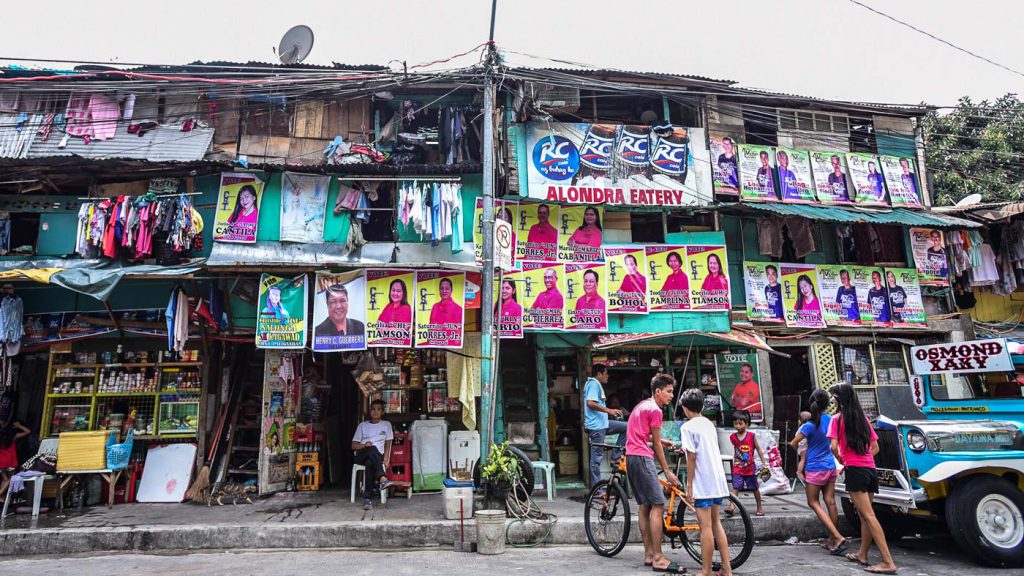
Campaign materials for the Barangay and SK elections along Roces Avenue in Quezon City on May 10, 2018. Photo by Maria Tan/Rappler
The pomp and all too sudden generosity we only witnessed from the mayoral and congressional wannabes had already seeped into the barangay level. It is just amazing, fucking amazing to witness how some kagawadand barangay chairmancandidates could provide a poso or visit a birthday celebrant’s party and shower them with a variety of gifts. They attend the funeral rites of a friend of a friend, meet and greet the elders, have pictures of them taken carrying a child or kissing a filthy old man, and whatever.
They visit you, shake your hands, and beg for your vote. Together with their so-called supporters, they roam the streets riding an ‘owner jeepney‘ equipped with loudspeakers playing a song by Inigo Pascual with modified lyrics to promote their advocacies—same old stupid scene.
What are their advocacies? It varies from very personal to general, but regardless of their advocacies, what they would do remains blurry and puzzling.
And let us not forget the one-liners of these “prominent” candidates. Their print ads read “Maaasahan mo” (Someone you can lean on), “Ipaglalaban ka” (I would fight for you), “Ang Tatay ng Barangay” (The patriarch of the barangay), “Kay Dodong, Panalo Tayo” (With Dodong, we are the winners), “Una Ka Kay Manang Tasya” (You are the priority ofElder Tasya), and other fascinating promises.
No matter how sweet and promising their one-liners are, they do not seem to meet or even exceed the standards of good governance.
The country is notorious for its corruption—down to the ‘barangay’ level
A perfect example would be the one who campaigned on the slogan that he is “someone you can lean on”. Leaning on, in the context of public service, is neither the ‘kagawad‘ who would provide the cases of beer during the birthday party of a barangay member nor the barangay chairman himself who would shoulder the sacks of cement for house construction.
“Someone to lean on” is a leader who organizes scholarship funds and livelihood programs. To ensure that the jobless are encouraged to join a business cooperative. Every barangay member is taught garbage segregation and proper disposal. That no one is seen consuming alcohol or smoking in public places, or even simply to espouse cleanliness and discipline, is to say that thebarangaychairman is genuinely someone you can lean on.
“Ipaglalaban ka” does not mean that when a person is the cause of a brawl, all he has to do is to ask for the help of kagawad, and his wrongdoings would be tolerated and that he would be defended no matter how wrong he is.
When a candidate pledges that “he would fight for you,” he will defend what is morally right even if the deed is deemed unpopular. Fighting for someone is fighting for the rights of the oppressed, whether he is your associate or not.
When someone claims that “he is the patriarch of the barangay,” he should see that his words and actions are acceptable. He should take concrete steps to maintain the health and well-being of every barangay member by integrating medical missions –just like a father who wants all his children to be healthy.
He should not take sides during barangay hearings; instead, he should punish the wrongdoer. The punishment should be like this: it comes from a concerned father who does not want his son to become the bane of the barangay. The world has too many assholes already.
While the candidates enjoy the perception that the people appreciate them for their advocacies and promises, they appear to be ignorant of the long-term needs of their constituents. They usually offer short-term and patchwork solutions to the same old problems that have been haunting and destroying Filipino values for centuries.
This is where I pity Kuyang Rey and most Filipino people. While the concept of self-reliance and the value of hard work.
A lack of money is no excuse for working-class Filipinos to rely on others, especially politicians. By giving Kuyang Rey’s family the poso, the candidate did not help him. It only made Kuyang Rey even worse.
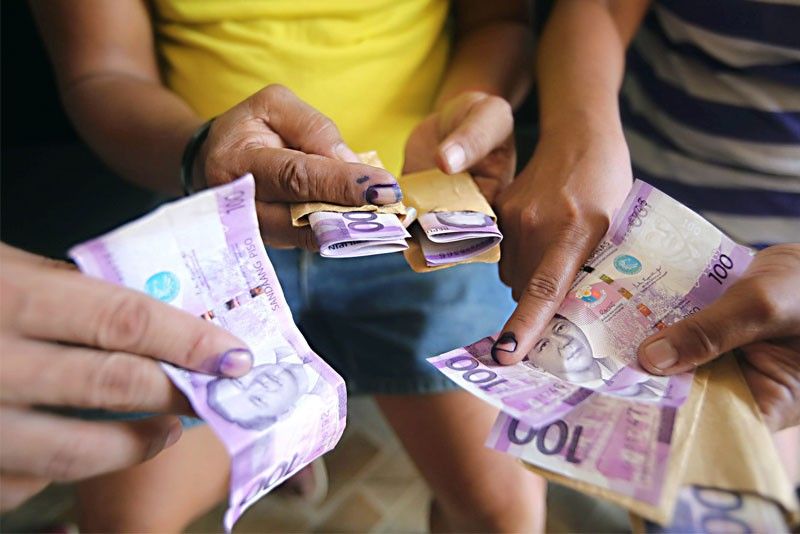
Money for your vote.
After all, it is not the barangay chairman’s task to provide a family with a deep-well pumping machine; it is the job of the “padre de familia” (head of the family) to invest in all the essential things his family needs. It’s not the church, DSWD (Department of Social Welfare and Development), PCSO (Philippine Charity Sweepstakes Office), or other charitable organization responsible for one’s needs, but the person himself.
Instead of the poso, a well-meaning politician would rather coordinate with the water company so that everyone in the barangay would benefit, not only a few families.
Instead of construction materials, why not gradually help the person find a decent job to build his house from sweat?
Instead of movie passes to get the teen votes, a resource speaker can be invited to the barangay hall to give English proficiency classes.
‘Poso’ is suitable for only one family, but an efficient water distribution system benefits the entire community.
A hundred-fifty hollow block is good only for Aling Bebang’s comfort room, but a job opportunity would enable every father in the barangay to build a house of his dreams.
A movie pass or two would be a temporary escape from the harsh realities of life, but an English proficiency class could equip them with confidence in finding a job.
Ah, to hell with the shallow minds of these politicians. Politics is as dirty as a charcoaled rug.
As I wrote this, my drinking buddy texted me that Andong would come to our compound tomorrow to shower us with paper bills. Lots of one depicts the face of a brilliant senator assassinated at Manila’s main airport in the early ’80s — the five-hundred peso bill.
Maybe the money is enough to buy me a pair of jeans, a cellphone ‘load‘ good for a month, or even wax and tire black for my dying jeep. After all, the entire barangay won’t even know if I sold my soul.
Nah, I’ll sleep all day tomorrow, and Kuyang Rey will never be able to wake me up, even with a megaphone.
Who would not want a new car or a new SUV? I mean, in a poverty-stricken country like the Philippines, it is very sardonic to see that while most people still complain about not having enough money to make both ends meet, the majority still quench their insatiable thirst for imported cars, be it through installment plans or cash.
Go to the nearest highway, and one would see a fleet of Fortuners, Monteros, Imprezas, Accents, and many more Japanese, American, or European cars passing by the ramshackle jeepney — pure mockery at its very best.
For coffee lovers and those who are pretending to be such, who can resist a posh place like Gloria Jean’s or Seattle’s Best for a tall, expensive frap, frape, prafe?? Well, whatever the spelling is and a small and costly blueberry cheesecake. After all, nobody wants to miss the complicated bar counter, behind which all the blenders and grinders are displayed as if to remind you they really do process your cappuccino. Have you noticed how foreign coffee shops have sprouted all over the archipelago and have slowly but surely taken the place of malls, parks, fast-food chains, and even cockpit arenas?
Well, that is just coffee, let us switch to technology. When it comes to cellular phones or other gadgets, Filipinos would never ever be the last human race to use the latest Apple-manufactured piece of communication device, despite the fact that it really is expensive.
A phone is a necessity these days, but it makes me wonder why an average Pinoy (Filipino) worker, despite the daily earnings of the minimum wage, which just suits his payment for house rental, electricity, water bills, and food, opts to purchase this product of the late Steve Jobs over the cheaper phone. A 45,000-peso phone, or over 3,000 worth of a locally made phone? Come on, it’s no longer a matter of freedom or choice –it’s already wanton frolic.
English: La Loma Cemetery in Manila (1900) was used as a fort by the Filipinos, shelled by Dewey. (Photo credit: Wikipedia)
Apart from the purchase of imported cars, brewed coffee, and sophisticated phones, there are other things that really violate our sense of nationalism. A perfect example is Filipinos who spend their life-savings just to set foot in foreign countries for vacation.
Filipino travelers would often blurt out, “There is a promo for a one-week stay at the Venetian in Macau, let’s grab it,” or “I will never ever get to visit Singapore again, so why don’t we grab the Cebu Pacific promo?”
Visiting foreign countries and cities, rather than touring local places like Dingalan, Pagudpud, Puerto Princesa, or even the overly abused Boracay, gives everyone the impression that there is no decent place to visit in the Philippines at all. It’s no wonder that travel agencies promote scenic areas in other countries, such as the Forbidden City, Tiananmen Square, and Sao Paulo Beach. They know how to flatter Filipinos because they can see through us.
There really is no accurate rationale as to why we are into anything external or foreign. The closest thing to support the notion of colonial mentality among Filipinos is that we have been conquered by a handful of colonizers. In Teodoro Agoncillo’s book “History of the Filipino People” (1960), the author stated that long before the arrival of the Spaniards in 1521, we had been in constant trade with the Chinese people. The trade, which was then called the “Porcelain Trade,” probably started centuries before the advent of the Sung Dynasty. The Chinese exchanged silk, porcelain, colored glass, beads, and ironware for hemp cloth, tortoise shells, pearls, and yellow wax of the Filipinos. The exchange of goods started as early as 960 AD, before the accidental arrival of the Spaniards in 1521.
And so it happened.
Original caption (cropped out): Native boats and outriggers. Description: (cropped out): Boats of the upper type were used to land the U.S. troops at Manila. One of those in which the Astor Battery landed sank in the surf just before reaching shore. The natives carried the men ashore on their shoulders. The lower boat is a fisherman’s craft used by the Negritos, who shoot fish in the clear water with bows and arrows. (Photo credit: Wikipedia)
The arrival of the European conquistadores brought a new phase and meaning to the lives and mindset of the Filipinos. We learned to integrate Spanish into our own language, even naming the Philippines after the Spanish crown prince who ultimately became king (King Philip II). Provinces in the Philippines were renamed with Spanish names, such as Nueva Ecija, Nueva Vizcaya, Laguna, Isabela, La Union,Antique, Marinduque, Negros Occidental, Negros Oriental, and Valle de Compostela. Beyond this naming of places, the greatest influence the Spaniards have left us is the faith in Roman Catholicism. Filipinos at home set up an altar in the Hispanic tradition, adorned with Catholic images, flowers, and candles, as they have internalized the observance of fiestas (religious festivals), devotion, the rosary, baptism, and many more.
Along came the Americans. After the defeat of the Spaniards by the Americans, led by General George Dewey, in the war dubbed the “Battle of Manila” in 1899, the Americans took the liberty of controlling and influencing the Filipinos. In the early years, there were conflicts between the US and the Philippines, but during World War I, they came together, and the Filipinos fought alongside the Americans, and their relationship became much friendlier.
As we solidify our pact with the “land of the free and the home of the brave“, we become more attached to their customs and traditions. Nobody can deny that the greatest contributions Americans have made are democracy and education. To cite all the things that we inherited from Uncle Joe is impossible, for they are innumerable. American influence on Filipino clothing is apparent to this day. We often see people wearing belts, suspenders, tennis shoes, bonnets, high heels, and cosmetics. For food, Filipinos are accustomed to U.S.-based staples like hamburgers, sandwiches, oatmeal, ketchup, apple pie, mayonnaise, hot dogs, steak, ice cream, cornflakes, and many more.
Seventy-one years have passed since the Philippines tasted true freedom and democracy, yet its beloved citizens are still, or should I say, intentionally glued to anything that is international in concept. Our colonial mentality should no longer be attributed to the colonizers because, for a long period of time, they are gone. After the Second World War ended in 1945, the US declared that we were an independent nation and that we would, from that moment, stand on our own, build our own nation, govern our people, and make ourselves proud of what we could make of our country.
Yes, we have been standing on our own. For quite some time, we have been electing our leaders, we have drafted our constitution dedicated to democracy, we have been blessed with job opportunities, and we have seen the ingenuity of many of our fellow countrymen in the fields of business, the arts, academe, and even sports. When accumulated, these things would foster national pride and patriotism. But the “accumulation” never happened in the Philippines.
English: Depiction of the flag of the Philippines, as conceived by Gen. Emilio Aguinaldo. Created with Inkscape. (Photo credit: Wikipedia)
Nationalism and patriotism are things not difficult to conceive. It is just a matter of self-worth, confidence in the citizens’ competence, and pride. Just take a look at Japan, its people may be ridiculed for being awful English speakers, but nobody can take away the fact that it is a land with citizens deeply attached to their flag, to their country, and to their identity.
By despising imported goods, Japan was able to produce its own products in the fields of automobiles, heavy industries, and gadgets. Everyone is definitely familiar with brands such as Toyota, Mitsubishi, Honda, Nissan, Subaru, Yamaha, Kawasaki, Sony, Sanyo, and the list goes on and on. The same principle of nationalism applies to countries like Germany, Italy, France, and even China.
While more and more countries are gradually realizing the essence and beauty of selfhood, the story is different here in the Philippines. Here, the bandwagon culture is a cliché: We have been deeply in love with anything Western in concept. We always want to exclude ourselves from the bondage of traditionalism, and although it does not manifest verbally, we always deny our being Filipinos, for we love imported goods.
Just how badly have we opposed our being Filipinos? Instead of settling for a more affordable and locally-made brand of leather shoes, a typical Filipino would hand his ever hidden credit card to the ethical staff at the counter in exchange for the expensive and imported Kickers, Hush Puppies, Timberland, or Oleg Cassini. I’m sure the reason isn’t about durability or longevity.
What about the means of transportation, particularly cars? Try going to EDSA, and anyone would notice that many billboards post inviting marketing strategies like “Vios, 20K Downpayment, No Hidden Charges.” Car manufacturers know that the Philippines is and will forever be a third-world country, yet they still thrive in selling cars to us. And the business is so good that everywhere you turn, there will always be car casas (dealerships) regularly visited by an average businessman, a call center agent, a teacher, and even a college student whose dad is a seafarer.
The funny thing is that people purchase cars for the reason beyond practicality – that they work near their residence and they don’t need cars at all, that they know that the streets of Manila are just like a huge parking space during rush hours, that they know that sooner or later they would have their car pulled out by the bank because they could no longer afford to pay for it. Pathetic as it may seem, Filipinos buy imported cars, not for a reasonable cause but to delight their ego.
Gadgets are undeniably a necessity nowadays. In a fast-paced world, people need smartphones for easy access to email, messages, and important and unimportant calls. We are not Amish people whose contentment rests on their shrugging at what is contemporary. But while it is clear to us Filipinos the value of gadgets, particularly cellphones, it remains an enigma why we settle for expensive, imported brands. Is it the speed? I bet locally made phones are just as fast at processing. Is it the phone’s user-friendliness? I’m certain it is also easy to write text messages on My Phone, Torque, and Cherry Mobile. Is it the design? The size? The weight? The color? Or is it the brand?
To realize just how strong our attachment is to Apple, Samsung, Asus, and other foreign brands, just look at students, people in the BPO industry, people in the corporate world, service crew at a fast-food chain, construction workers, and even the jobless and bystanders. They all have this phone with an apple with a bite taken out of it on the back. Parents would give their kikay daughters an imported phone on the latter’s birthday, saying, “You deserve nothing less, anak (my daughter)”. A service crew would avail of an iPhone 7 even if it meant paying for it over the full 12 months at a staggering 30% interest rate. Truly amazing. What is funnier is that the same features found in these imported phones can also be found in locally made ones… at a reasonable, lower price.
Then we have our fellow kababayans (countrymen) who love to travel, as discussed earlier. They go to France to see that tall, metal structure in Paris. They travel to Hong Kong to ride the roller coaster at Disneyland and take a picture with Mickey and Donald. They travel to Cambodia to see the largest religious monument in the world, to see the lovely bones of the victims of Pol Pot, and to see where the film “The Killing Fields” was filmed.
They travel to London to ride The Eye, to have a selfie with Big Ben in the background, to walk at Trafalgar Square, to watch the concert of Ed Sheeran at Hyde Park, and to feel the bloody English weather. They travel to Kenya to pose with African children, ride a Land Rover, see animals on the Serengeti Plain, and hunt and shoot poor antelopes to get their antlers. The farther they travel, the happier they become. As the number of countries they have visited increases, they become more satisfied and proud.
Ancient Filipinos utilized terrace farming to grow crops in the steep mountainous regions of the northern Philippines. (Photo credit: Wikipedia)
The author sees no problem with these explorations and escapades, for travel equates to education. When one travels, they gain firsthand experience and accounts of what is really going on around the world. After all, it is their money they are spending. What is bothering is that while these Filipinos crave the elegance of international tourist spots, they fail to notice the grandeur of the Philippines.
What about visiting Camarines Norte for surfing, Baguio for the cold weather and for upland fruits and vegetables, Puerto Princesa for an underground river tour, Ilocos Norte for sand surfing, Quezon province for a series of pilgrimages, and even Intramuros for a look back at how our beloved Jose Rizal (the country’s national hero) spent his last few hours.It is painful to see Filipinos flock to distant lands for leisurely visits and neglect the scenic places in our own realm. It is as atrocious as not wanting mom’s home-made adobo and preferring to eat at a swanky restaurant.
Why Filipinos are suckers for anything that is Western in concept remains a riddle. Youngsters who play basketball in the streets of Manila are often seen wearing Nike. Yes, Nike, the company that employs minors in China. Ask them why such a brand is chosen, and not MSE or Natasha, and you will be bombarded with answers like “It’s light, it’s durable, it’s classy, it unleashes the athleticism in me, blah, blah, blah”.
True enough, the aspect of toughness is unquestionable. The catch is: why do some kiddos and teenagers wear imitation Jordans and Kobes? I’m sure it is not a matter of the shoes’ reliability, because class A’s are made with substandard materials. The painful truth is that we are only after the brand – to be noticed, to be seen as prosperous, to be on the bandwagon, to wear what the wealthy people wear, and worst of all, to be accepted.
For automotive enthusiasts, it is almost taboo to purchase a Cavite-manufactured owner-type jeep. A typical dad could never force his teenage daughter to be taken to school in a filthy owner’s jeep because for the poor girl, it is baduy. A typical white-collar guy would not want to go to Starbucks, parking his stainless steel owner jeep next to Foresters and Ecosports. For sure, it will be photographed by the Conyos and ridiculed as a “fly in a glass of milk”.
Nowadays, what is cool should be the possession of pick up trucks ridden by the tough guys in Texas (even though pick up trucks are built for farm or ranch and not for urban areas like Manila), possession of a muscle car that is a prototype of what Vin Diesel used in his famous movies about racing, possession of Maserati, Ferrari and Lamborghini even if these cars were designed only for wide freeways, something which we do not have. Can you imagine what it is like driving a Lambo in the chaotic and narrow streets of Manila? The Philippine-made owner-type jeep is really the perfect toy to roam our dilapidated streets. Again, when it comes to cars, the concept of colonial mentality overpowers our sanity.
Readers might question the author’s dislike of buying imported stuff. Critics would say, “It is our hard-earned money after all, and we have all the liberty this world has to offer when it comes to purchasing whatever we want to buy”. True enough, we are entitled to our decisions, and nobody has a right to tell us to buy this and not that, to do this and not that.
But the underlying dangers and drawbacks of colonial mentality are as bad as self-destruction. Naïve people who love to sport their Jordans, Ford Everest, Fire Floss from Le Couer de France, and Sperry Top-Sider without directly realizing their effect on our economy and our morality as Filipinos. By buying Jordans, we strip our local shoemakers of the chance to show their creativity, brilliance, and earn a living. By buying iPhones rather than Cherries and Torques, we are, backhandedly, telling our homegrown electronics engineers, technicians, and IT experts that their toil does not merit our applause and support.
We always degrade locally made gadgets, and we often complain that they are difficult to use. But we should also recognize that the very reason local companies could not manufacture better versions is that they lack the support of Filipinos. Should we buy their Cherries, the company would generate enough funds to upgrade their phones and tablets. Moreover, by buying Fortuners and Monteros, we are closing the door to producing our own automotive brand.
If you visit the Sarao Jeep Company factory in Las Pinas, you would see how grubby and sordid the place is. Workers are without sophisticated machinery, without definite buyers, and, worst of all, without hope. But just as dirty and blackened the hands of these patriotic workers are, Filipinos’ hands are also dirty. We can never wash our hands of the dirt of our distrust in the capability and competence of our local car makers. How I wish that in my lifetime, I would be able to drive a vehicle made in the Philippines and manufactured by the Filipinos.
The damage of the colonial mentality does not only extend to the economic aspect. More than currency, colonialism deeply cuts through our sense of national pride, which will leave us bleeding until the death of our morality. By buying goods from other countries, the notion that the Philippines cannot produce anything good will boomerang to us, and it will haunt even our posterity.
Colonial mentality is a vulgar display of our dislike for anything Filipino, which reflects our self-hatred. But worse than patronizing anything international, we are already longing to be what we are not. We Filipinos, for a long period of time, have done idiotic things to escape our beautiful identity. We blonde our hair, we apply skin whitening lotion, we imitate the accent of the stupid newscaster from the BBC news, and we indirectly deny our being Filipinos. This reality crushes me into pieces.
We may not possess the wealth of superior countries, we may not have those Ferrari, Aprilia, and Ducati factories that are regularly featured on the National Geographic Channel. We may not have the tallest building on earth, the fastest train, or the cable ride overlooking the snow-capped mountains like those in the Rockies near Denver, Colorado. We may not have the pointed nose, the so-called superior white skin, or the “bloody” British accent.
But Filipinos are superior in a different sense. We are a beautiful people whose resiliency has defied and thrown oppressors in the past. We are a beautiful people whose soil is fertile, enabling us to grow delicious fruits and vegetables. We are beautiful people who, despite the hardships of life, flaunt a contagious and genuine smile to encourage others. And since we are beautiful, it is not impossible for us to produce beautiful things in the field of science, arts, economics, technology, and the like.
There is no need for a colonial mentality, self-hatred, or distrust of our potential.
We are beautiful.
(Ronald B. Polong is a frustrated writer who removes his dentures before he sleeps and places them in an empty Cheez-Whiz bottle, with water, of course. He currently lives in Nueva Ecija with his wife, three boys (two are twins), a brood of roosters and hens, ducks, and an old dog.)
I have to admit that it took a very long time before I realized that those seemingly entertaining casino sorties that we have had in the past years almost made me among the stupidest people in the world.
It took me a lot of time to finally realize that casinos are simply mass financial slaughterhouses designed to make fools out of people and to take away their hard-earned money by utilizing all schemes – devious or not – possible.
In these days and ages of social media, some people even take their foolishness to new heights by posting their casino addictions primarily via “vlogs” (video blogs) on YouTube, Vimeo, and other websites. Most of these poor, misguided souls get their highs from playing the slots machines and by the number of visitors or ‘hits’ on their vlogs — and they think they are popular when their vlogs get viral.
Casino owners and operators are simply laughing: these gambling addicts provide free advertising for the casinos, and vlogs promote gambling to a much wider audience. This is just another foolish denial of the gambling addict and a means to legitimize one’s vice.
It’s only a matter of time before casinos get all they have. The others who claimed fun, food, strategy, discipline, and additional self-deceptions have been sucked in, chewed up, and spat out.
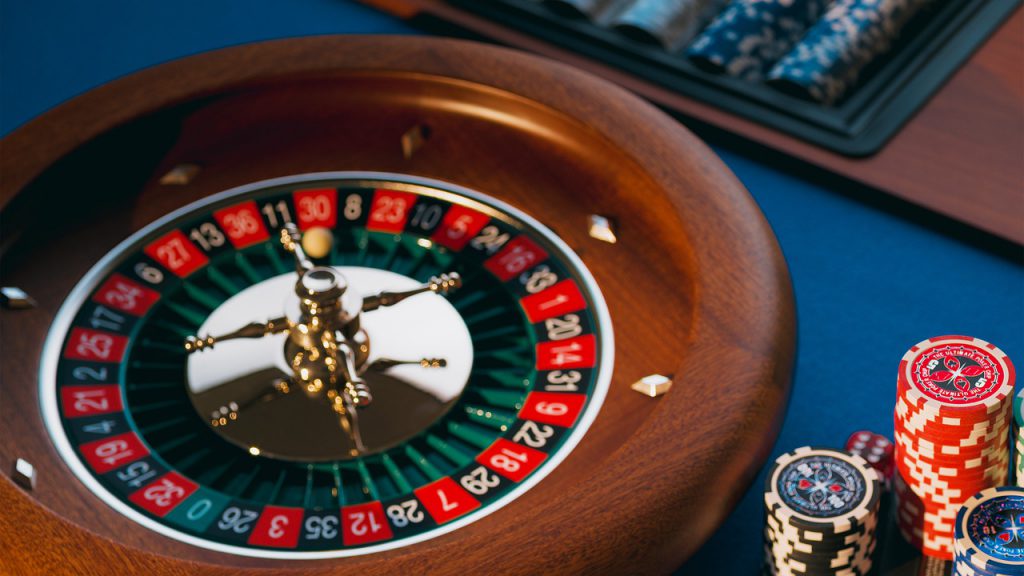
Roulette Roulette Table Chips Money
In addition to their massive mailing & advertising campaigns, casinos employ people called “VIP Hosts” to cater to gamblers with lots of money to lose. These scumbags will seemingly give big-time gamblers attention and care while milking away all their money.
The whole premise of a host is to extract as much money from players as possible. Casinos award hosts bonuses based on how much the gambler loses. This is pure and simple evil.
Entertaining or not, there is always a sinister feeling that I get each time I enter a casino – – or any gambling establishment. Entering one, you get sucked into a place that distorts your concept of time and money.
Time and money: that’s what the casinos take away from ordinary folks out to have a good time or hard-core gamblers.
More than money, it’s that valuable time you lose for the rest of your lives while you’re inside casinos that make you much more foolish than you think otherwise. The time I wasted is no different than what a prisoner loses while locked up in jail.
All for what? Wasting countless hours staring and pressing that ‘BET’ button in slot machines (yes, casinos try their best to make them more animated via more giant screens and louder speakers) simply to watch a virtual reel spin on a colored screen?
These man-made contraptions have what the casino industry euphemistically termed a ‘random number generator.’
The truth is these machines are designed and programmed to bring guaranteed financial ruin to any casino habitué who had that fantastical notion that they can make these gambling establishments their ATMs.
The key word is here is: “programmed”. So, how can you beat a machine – in the long run – that was designed and made to pay out lower than the amount of money you put in?
Now that I have just mentioned ATMs, some casinos offer “NO ATM FEES” inside their places. Mind you, this is not a service to help people out but just another one of their many devious schemes to facilitate the transfer of people’s hard-earned savings and checking accounts to the casinos’ already-fat accounts.
Watching the green baize while your bankroll dissipates because of the huge casino advantage is no fun.
And all along, their second-hand-smoke-smelling employees quietly (or, sometimes, brazenly) celebrate that they had legitimately defrauded people of their nest eggs yet expect tips from those they had just robbed.
It’s OK to lose your time and money for a worthwhile cause but lose both inside a casino? Casinos provide all the tools to make a person stupid. Just think about it.
There are better and much more exciting things to do in one’s lifetime than spending the bulk of your time inside a casino.
It took me a lot of time before I finally realized that I was punishing rather than entertaining myself when I went to a casino.
Casinos also fool you about the “real-world” concept of money. You give them real money, but they give chips or a piece of paper in return. These simple diversions are mere ploys that make it easier for them to take all your real money.
Casinos also fool you by giving the illusion that whatever you lose, you can have it all back with a single ‘lucky break’ — a break that will never come.
How can a good thing come out of a place borne out of a devious scheme?
For people who still have difficulties seeing through the lies and deceptions of casinos, it’s just a matter of admitting you have an addiction. And the realization that casinos do their best to get you deeper into that addiction.
No matter how hard casinos try to trick people -through their massive advertising campaign- into believing that their places are just fun, you can have a good time. This may be okay if you possess that super willpower(in reality, this feat is almost impossible as we’re all just human) and simply go to a casino to eat, drink and be merry and not have anything to do with their slot machines and table games…then go straight home.
But that’s the initial bait casinos have laid out for people on their path to financial ruin. While inside a casino, the lure of these money-draining slot machines and the hard sell of their dealers to play those table games whose odds of winning are stacked heavily against players are simply too hard to resist.
Some may have wised up and gotten scared after realizing they were in a life-stealing vortex. Others simply fell into the same trap and lost all their money. But, newbie gamblers with fresh faces filled with excitement, hope, and gambling naïveté fill the spaces left by those fun-seekers who have deceived themselves at the hands of the super-slick gaming establishment.
So, why fall into these traps laid out by casinos when you can have a better time with your family and friends in honest-to-goodness places that serve better food and entertainment?
Casinos, therefore, are just a trap borne out of a devious scheme — for your financial ruin and for you to become a prisoner by way of the precious time you lose when you’re inside one.
Most people will recognize their lack of power to solve specific problems if they are honest. When it comes to gambling, I had noted – including myself – that many problem gamblers could abstain for long stretches but were caught off guard and, under the right set of circumstances, started gambling without thought of the consequences.
Through willpower alone, the defenses they relied upon gave way before some trivial reason for placing a bet. Willpower and self-knowledge will not help in those mental blank spots, but adherence to spiritual principles solves our problems.
I believe that to believe in a power greater than ourselves and to acknowledge that gambling is evil are necessary for one to sustain a desire to refrain from gambling.
So, don’t let casinos make a fool out of you. Avoid them by all means, at all costs, and recognize them as places of evil.
Remember when you see that big “CASINO” sign, whenever and wherever you are: You will lose your CAsh and visit a SInister place… so, just say NO.
God of Heavenly Punishment (Photo credit: Wikipedia)
“There was once a very, very rich man who found that riches did not satisfy. His name was Solomon. He wrote a book about it called Ecclesiastes. This rich king had tasted just about everything life could offer. Wealth? No one could exceed him in luxury. Wisdom? The whole world knew how wise he was. Fame? He was king, the most famous man of his time. Systematically he sampled all of life’s pleasures and powers, yet all ultimately disappointed him. All prove meaningless.
“What is the point of life?” he asked. You worked hard, and someone else gets all the credit. You struggle to be good, and evil people take advantage of you. You accumulate money, and it just goes to spoiled children. You seek pleasure, and it turns sour on you. And everyone–rich or poor, good or evil, meets the same end. We all die. There is only one word to describe this life: meaningless.”
But, is it? Is life really meaningless? Is that all there is in life –the summary of the number of years we had live in this planet? Does man’s existence on Earth simply goes and on until this planet or the entire universe gets obliterated by a decaying sun?
Surely, when humans try to ponder the unknown, tons of questions need to be answered. Is there such thing as an afterlife? Is there a God?
In our vain attempts to give even the most preposterous explanations to the great unknown, they had also given rise to a multitude of religions, sects, cults, tribes, fan clubs or what have you.
On the other hand, mankind has been trying to use every scientific means to disprove any religious theories about the creation of just about everything the mind can think about. That the universe – which our planet is but a tiny speck within – is but the result of a mega blast and that humans simply came about through a series of evolutions.
And that everything that the human mind could comprehend simply happens randomly. Really? Everything is just random?
Each individuals’ appearance on this planet may have occurred randomly at birth but have you ever wondered why life spans differ? There are souls that don’t even see the light of day, others die young while some of our elders even express their desires to die so much earlier in their struggle to cope with the hardships and difficulties that accompany old age.
In the worldly context of King Solomon‘s search for life’s meaning, he also voiced the unfairness of life:
“People don’t get what they deserve. Good men suffer while wicked men prospers. Everything seems determined only by time and chance.”
And just how many times we had asked ourselves that we deserved more in this life? Why does success, in whatever means we try to measure it, seem very elusive? Why do we see other people seem to have all the comforts of life while others still wallow in poverty?
On the other hand, why do some people so suddenly give up a life of unbridled extravagance to be of service to the poorest of the poor — and find their true happiness in the process?
Our futile attempts to quantify life and find meaning in it is hampered, of course, by our very own making: the concept of time.
Time is the great equalizer and it measures, regulates and rule each and everyone’s lives. There are no exceptions and short cuts. We will all die.
Science and technology may have found some solutions in making our daily chores so much easier and, on a few cases, extend our lives a few years longer. But, there will never be an eternity for us in this planet as long as there is the concept of time.
We could all be likened to a mouse trying to catch its tail.
English: President Woodrow Wilson addresses the United States Congress early in his first term. (Photo credit: Wikipedia)
A once-in-a-lifetime occurrence, 11/11/2011 had been deemed by the Chinese as the luckiest day to get married. For them, it’s the best day to leave the single life behind.
In the U.S., 11/11 is Veteran’s Day – a national holiday. It was President Woodrow Wilson who proclaimed this holiday on November 12, 1919 to celebrate the signing of the Armistice that ended World War I.
It’s merely coincidental that holiday is on its 92nd year of celebration in 2011. The sum of 9 and 2 also yields 11.
For this author, 11/11/11 is the luckiest day in his lifetime. He gets all the 11s and a 6.
This author salutes all the war veterans – as well as all the newly weds – on this special, once-in-a-lifetime date!!!
English: Apple IIe computer (enhanced version) (Photo credit: Wikipedia)
Since I had my first Apple II back in 1980, I had looked-up to Steve as my idol. He was brash, handsome and had that unmistakable air of invincibility in him.
I don’t believe in miracles and magic but I had an epiphany when I laid my eyes on the Apple IIe inside that store in Saudi Arabia. It seemed to have a halo above it — the company has something special going for it.
What followed for Apple from 1982 through nearly the end of 2011 could probably never be repeated again in world business history.
Every weekday, after arriving from work, I always see my father, in his advanced age of 90, sitting on the La-Z Boy.
That may not seem unusual but for the past 3 years, he had been talking more and more – and, in a very loud voice to almost everyone to who sets foot in the house. Again, talking to someone may not seem unusual but, again, his repetitive harks to attract somebody’s attention – – he will call out one’s name almost ten, if not, twenty times, just to engage that person in his typical convoluted kind of conversation.
The medical student in me, tells me that something wrong is now going on in my father’s brain. Dementia, Alzheimer’s disease, “over-emotional-outburst-of-a-person-in-advanced-age-syndrome”…whatever the medical community may call it, but, the fact that for some people who have the luck to live their lives for that long, will eventually, fade out in time.
Our bodies are not as durable as steel or plastic.
I am sad all about these because I had believed in an omnipotent God for the most part of my life.
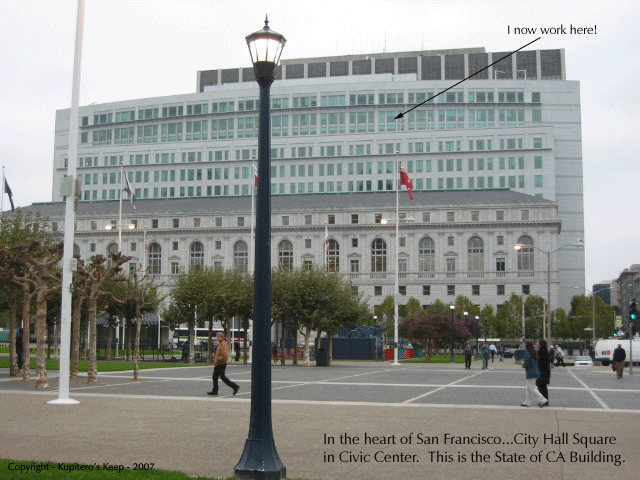
The State of California building as seen from the park across SFO City Hall
Since I moved working environs from Fairfield to SFO in late August this year, I hardly had the time to update this site. San Francisco is such a bustling city that getting used to this new lifestyle will take me some time.
Fairfield was really so boring, after all!
What’s coming up? I have on tap, more new computers & gadgets, new software (including Apple’s latest OS X Leopard), more world music, news and more importantly, will upgrade the webserver to a massive two (2) terabytes of storage space!